Phys 426: Stratified Flow and Instability
Martin Williamson | V01013463
Introduction
Stratified Two Layer Flow
Under hydrostatic balance, a fluid at rest satisfies the condition that the vertical pressure gradient force balances the gravitational force:
$$\frac{\partial P}{\partial z} = -\rho g$$Integrating this equation vertically gives:
$$P(z_2)-P(z_1)= -\int_{z_1}^{z_2} \rho g \, dz$$For a two-layer fluid with densities $\rho_1$ and $\rho_2$, where $\rho_2 > \rho_1$, we find the pressure to be given by:
$$P(z)=\begin{cases} P_0 + \rho_1 g (\eta-z), & z > -h_1 \\ P_0 + \rho_1 g(\eta+h_1)+\rho_2 g(-h_1-z), & z < -h_1 \end{cases}$$This means that the pressure at a given height $z$ is determined by the weight of the fluid column above that point. Here, $P_0$ is the reference pressure at a free surface, which is typically at the surface of the ocean, and so $P_0$ represents atmospheric pressure. The quantity $\eta$ then represents the displacement of the free surface relative to its mean position at $z=0$, and so $(\eta-z)$ gives the vertical thickness of water above the point $z$ in the upper layer, where $-h_1$ is the coordinate of the interface.
Next, to consider any horizontal movement, we should look at how pressure might vary in the x direction, i.e. $\frac{\partial P}{\partial x}$. The x-momentum equation tells us:
$$\frac{Du}{Dt} = -\frac{1}{\rho}\frac{\partial P}{\partial x}$$Taking the x derivatives for our $P(z)$ expressions gives:
$$\frac{1}{\rho}\frac{\partial P}{\partial x} = \begin{cases} g\frac{\partial \eta}{\partial x}, & z>-h_1 \\ g\frac{\rho_1}{\rho_2}\frac{\partial \eta}{\partial x} + g\frac{\rho_2-\rho_1}{\rho_2}\frac{\partial \zeta}{\partial x}, & z<-h_1 \end{cases}$$where $\zeta$ is the interface displacement.
This shows that horizontal motion is driven by horizontal pressure gradients arising from tilts in the free surface and the density interface. In the upper layer, the flow is driven only by the slope of the free surface:
$$\frac{Du}{Dt} = -g\frac{\partial \eta}{\partial x}$$In the lower layer, the flow is influenced by both the surface slope and the slope of the internal interface:
$$\frac{Du}{Dt} = -g\frac{\rho_1}{\rho_2}\frac{\partial \eta}{\partial x} - g\frac{\rho_2-\rho_1}{\rho_2}\frac{\partial \zeta}{\partial x}$$We can define the reduced gravity as:
$$g' = g\frac{\rho_2-\rho_1}{\rho_2}$$and rewrite the lower layer acceleration as:
$$\frac{Du}{Dt} = -g\frac{\rho_1}{\rho_2}\frac{\partial \eta}{\partial x} - g'\frac{\partial \zeta}{\partial x}$$If we consider fluids of two densities defined as:
$$\rho_1 \approx 1000 \,\text{kg m}^{-3}, \qquad \rho_2 \approx 1040 \,\text{kg m}^{-3}$$then the reduced gravity is:
$$g' = g\frac{40}{1040} \approx 0.0385g$$which means $g'$ is much smaller than $g$. This reduced gravity controls the restoring force of internal waves.
This also means that if the free surface is tilted by $1\,\mathrm{cm}$, then to balance the internal interface displacement we require:
$$\Delta \zeta\, g' = g\frac{\rho_1}{\rho_2}\Delta \eta$$or we can rewrite this as:
$$\Delta \zeta \left( g\frac{\rho_2-\rho_1}{\rho_2} \right) = g\frac{\rho_1}{\rho_2}\Delta \eta$$so that
$$\Delta \zeta = \frac{g\frac{\rho_1}{\rho_2}}{g\frac{\rho_2-\rho_1}{\rho_2}}\Delta \eta = \left(\frac{\rho_1}{\rho_2-\rho_1}\right)\Delta \eta$$For these densities,
$$\Delta \zeta = \frac{1000}{40}\Delta \eta = 25\Delta \eta$$so a $1\,\mathrm{cm}$ surface tilt corresponds to an interface displacement of approximately $25\,\mathrm{cm}$.
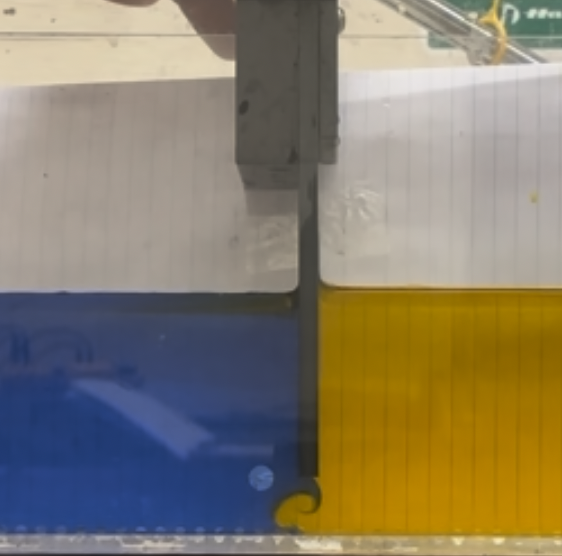
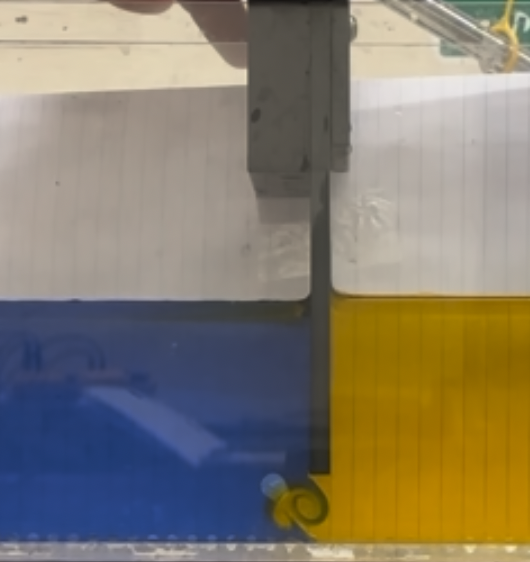
In this lock exchange experiment, two fluids of different densities are placed on either side of a barrier in a small channel; consider a situation where the denser fluid is on the left. When the barrier is removed, the denser fluid will flow underneath the lighter fluid (i.e. to the right) due to the pressure gradient force along the channel pointing from high to low pressure. Almost instantaneously, as the height of the fluid begins to increase on the right side of the lock exchange due to the denser fluid flowing that way, the lighter fluid will begin to travel to the left since it feels a displacement of $\eta$ from equilibrium. Since the restoring force is governed by the reduced gravity equation for this system (for the internal wave propagation), as the density difference increases, $g'$ increases. This means for larger density differences, the exchange flow is expected to propagate more quickly. Rottman and Linden (2002) showed that an energy conserving current that occupies one half the depth of the channel travels with a non-dimensional speed $U$:
$$U^2 = \frac{gH}{2}\left(\frac{1 - \gamma}{\gamma}\right)$$where $\gamma = \frac{\rho_1}{\rho_2}$, $g$ is gravity, and $H = \frac{h_1 h_2}{h_1 + h_2}$ for $h_1$ and $h_2$ the depths of each layer of fluid.
Since we have that the reduced gravity $g' = g\frac{\rho_2-\rho_1}{\rho_2}$, we can rewrite $\frac{1-\gamma}{\gamma} = \frac{\rho_2 - \rho_1}{\rho_1} = \frac{g'}{g}\frac{\rho_2}{\rho_1}$, and so:
$$U = \sqrt{\frac{g'H}{2}}$$For a channel of length $L$ with boundaries that reflect the wave, when the lock is removed and the fluids begin to move, the time $t$ for the disturbance to propagate from the lock at the centre of the tank to the first wall (a distance $\frac{L}{2}$) should scale as:
$$t \sim \frac{L/2}{U} = \frac{L}{\sqrt{2g'H}}$$Methods
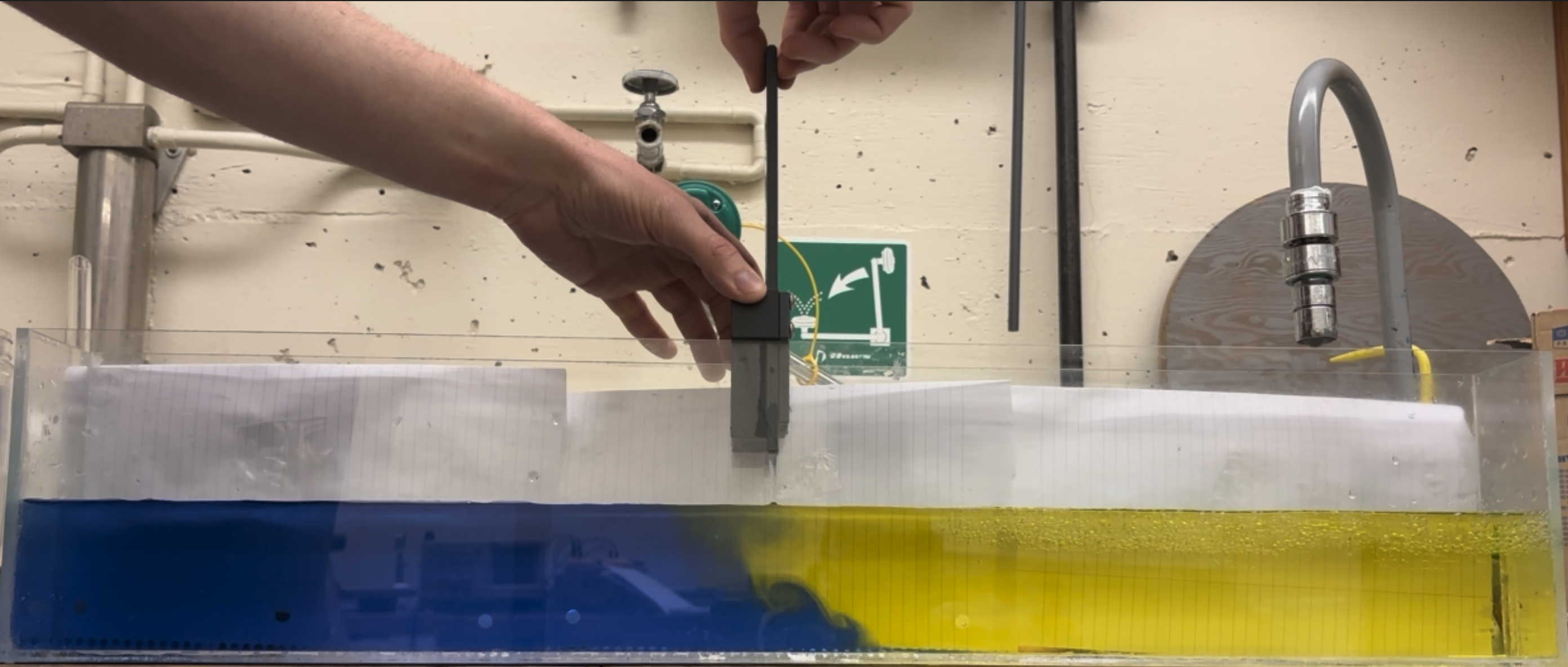
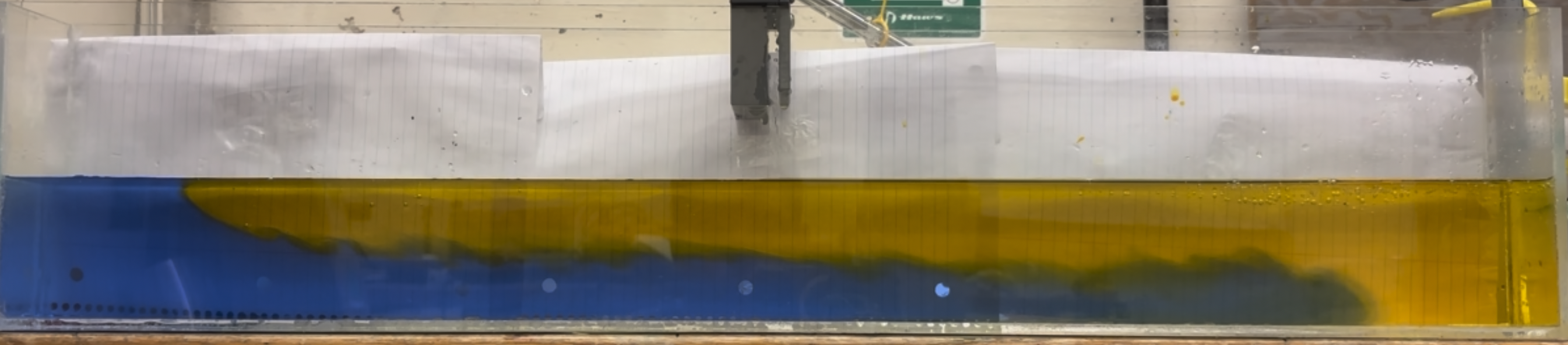
The channel used for the lock exchange was approximately 0.80m long. For each trial of the experiment, 2L of cold tap water was added to each of two large glass containers. For each trial, blue dye and a particular amount of salt was added to one container before being filled to 2L by the tap, and then was mixed thoroughly such that all salt and dye was dissolved and the solution was uniform. The other container of fresh water was coloured with an orange dye and also mixed thoroughly. The lock exchange was secured in place in the middle of the empty channel, and then each side of the container was filled with the 2L of water such that both sides were filled approximately to the same height, and this height was approximately 0.1m. The apparatus was then left to sit for 2-3 minutes such that any turbulence and water movement in either channel had time to dissipate and so that the water had fully come to rest. A video camera (iPhone) was set up on a stool to film, and the lock was removed. After the exchange occurred and some time had passed, internal waves had come to rest, and there was a two layer stratified fluid. Next, the lock exchange was carefully replaced, and one side of the channel was mixed thoroughly and dyed black. This solution was then of an intermediate density between the blue and orange layers. Again the lock exchange was removed, data was collected, and the solution was let to come to rest. This full process was then repeated for varying amounts of salt such that the density contrast between the layers was varied.
Calculations and Results
The density of each saline solution is estimated from the density of salt crystals and the total solution volume. Using a salt crystal density of $\approx 2.16\ \mathrm{g\,mL^{-1}}$ and a total volume of $\approx 2\ \mathrm{L}$, the density of the saline solution is calculated as:
$$\rho = \frac{m_w + m_s}{V}$$where $m_w$ is the mass of the water, $m_s$ is the mass of dissolved salt, and $V$ is the total solution volume. The time required for the disturbance to propagate from the lock at the centre of the tank to the first wall is measured from video analysis (Table 1). Using the reduced gravity relation with $\rho_1 = 1000\ \mathrm{kg\,m^{-3}}$, the reduced gravity is calculated for each saline case. We compare the theoretical travel time with measured and we find that increasing the density contrast led to larger reduced gravity and shorter disturbance travel times. The measured vs theoretical travel time results are inconsistent with the theoretical prediction, though the trend is consistent.
Table 1: Calculated densities, reduced gravity values, and measured and theoretical travel times for the lock exchange experiment. The final column shows the ratio of measured to theoretical travel time. Values above unity indicate that the observed propagation speed is slower than the theoretical energy-conserving prediction.
| Trial | Salt added (mL) | $\rho_2$ (kg m$^{-3}$) | $g'$ (m s$^{-2}$) | $t_\text{actual}$ (s) | $t_\text{theoretical}$ (s) | $t_\text{actual}/t_\text{theoretical}$ |
|---|---|---|---|---|---|---|
| 1 | 5 | 1005.4 | 0.053 | 27 | 15.59 | 1.73 |
| 2 | 10 | 1010.8 | 0.105 | 14 | 11.05 | 1.27 |
| 3 | 20 | 1021.6 | 0.207 | 12 | 7.86 | 1.53 |
| 4 | 40 | 1043.2 | 0.406 | 8 | 5.61 | 1.43 |
Discussion
In this experiment, we used a lock exchange with fluids of two different densities on either side of the lock to test two layer hydraulic flow theory, which proved to be less intuitive than one might expect. The observed propagation time for one fluid to move from the lock to a side of the tank after the lock was removed exceeded the theoretical prediction by a factor of approximately 1.3–1.7, meaning the gravity current travelled consistently slower than the energy conserving theory predicts. This difference appears more systematic than random, and since the ratio $t_\text{actual}/t_\text{theoretical}$ is similar across all the trials, this suggests there may be a physical explanation rather than experimental error.
The theoretical speed $U = \sqrt{\frac{g'H}{2}}$ is derived under the assumption that the gravity current is energy conserving, meaning no energy is lost to mixing, friction, or turbulence. In practice, these assumptions do not hold, as instabilities such as Kelvin–Helmholtz and turbulence were observed in the initial removal of the lock and as the gravity current propagated. Furthermore, observations of the gravity current as it propagated showed entrainment of the above surface layer, reducing the density of the gravity current and modifying its properties. In doing so, $g'$ is effectively reduced and so is the driving force, slowing the current. Other processes may be modifying the gravity current as well, such as viscous friction at the channel floor and walls, which act to dissipate energy from the flow, reducing the propagation speed, which would result in actual travel times that are slower than theoretical travel times. Finally, the theoretical result assumes the current is travelling at a constant speed, which is not quite observed.
Despite the disagreement with theory, this experiment does confirm the qualitative prediction of two layer flow theory: increasing the density contrast increases $g'$. With an increased $g'$, the propagation speed increases and thus shorter travel times of the gravity current are observed. The trend in both $t_\text{actual}$ and $t_\text{theoretical}$ is consistent across all trials. The fairly constant ratio between observed and theoretical times also suggests that the dominant source of forces slowing down the gravity current scales similarly with $g'$.
Conclusions
This experiment used a lock exchange to test the theoretical prediction for gravity current propagation speed in a two-layer stratified fluid. Across four trials, increasing the density contrast between two layers produced faster propagation times for the gravity current, consistent with the theoretical prediction that propagation speed scales as $U = \sqrt{g'H/2}$. However, the observed travel times were systematically slower than the theoretical prediction by a factor of approximately 1.3–1.7. We attribute this to energy losses from mixing, Kelvin–Helmholtz instabilities, and friction at the channel boundaries, which are not accounted for in the energy conserving theory. The consistency of the ratio $t_\text{actual}/t_\text{theoretical}$ across all trials suggests that the dissipative processes scale similarly to the density contrast, which means that the energy conserving theory captures the correct physical scaling even if it overestimates the absolute propagation speed.
References
Rottman, J. W. and Linden, P. F. (2001). Gravity currents. In Environmental Stratified Flows, pages 89–117. Springer.